Rethinking how local authorities make decisions: From fragmented data to collective intelligence
Local authorities now have access to vast volumes of data. Urban sensors, infrastructures and connected vehicles, public services: data is collected everywhere, all the time. Yet, in many cases, public decision-making remains relatively slow, siloed and more reactive than proactive.
Issues such as air pollution, noise pollution, infrastructure degradation and urban congestion can no longer be addressed in isolation. They are interconnected, cumulative, and evolve through dynamics that are sometimes difficult to understand.
At the same time, legacy decision-making models struggle to keep pace with the growing number of challenges.
More data does not lead to better decisions
One might assume that the exponential growth of available data automatically leads to better decisions. In reality, this is not the case, particularly because information is often analyzed separately, sometimes using different frameworks and indicators. Environmental data, mobility signals and infrastructure alerts - taken individually - struggle to reflect a broader reality.
Regional challenges are inherently interconnected. They require combining multiple dimensions: environmental, economic, operational and social. Without data orchestration and contextualization, decision-making remains partial.
The challenge today is to move from collecting data to using it collectively. Not by adding another technological layer, but by enabling data to become a shared language across all stakeholders.
Connected mobility as a foundation for real-time regional intelligence
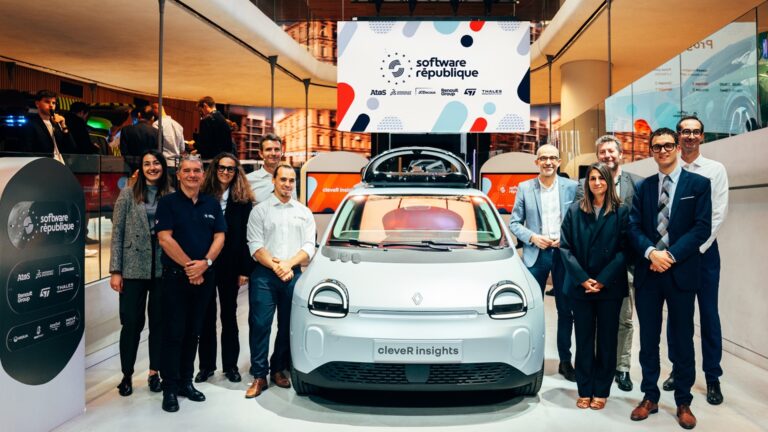
In this transformation, connected mobility plays a key role in collecting data from production vehicles, professional and dedicated fleets, and via the cleveR insights system, recently unveiled by Software République. It provides a dynamic and privileged observation point of the environment, capable of capturing information on road conditions, traffic, noise levels, air quality and even certain incidents.
This ability to collect data close to the field could be transformative. While fixed infrastructure provides a partial snapshot, mobility enables a more detailed, extensive, consistent and, above all, dynamic real-time view.
However, the value of mobility goes beyond real-time information capture. Its key contribution lies in anticipation. By analyzing weak signals and cross-referencing data from different sources, it becomes possible to predict risks and act proactively.
This approach also requires a multi-dimensional perspective. Events are no longer interpreted from a single angle; they are placed in a broader context.
Connected mobility thus acts as a bridge between traditionally separate domains, helping to build a shared view of the environment, essential for coordinated action.
Rethinking innovation for an ecosystem-driven world
This transformation cannot rely solely on technology. It requires a deep rethinking of innovation models across the wider ecosystem. No single player, public or private, can address these challenges alone. Collaboration between local authorities, industrial players, mobility operators, digital players and, more broadly, the entire territorial ecosystem is essential.
This collaborative approach is key to enabling integrated projects combining data, artificial intelligence, cybersecurity, connectivity and operational models.
Some initiatives already illustrate this shift, such as the cleveR insights solution developed within Software République, the European open innovation ecosystem whose founding members include Atos, Dassault Systèmes, JCDecaux, Renault Group, STMicroelectronics and Thales.
cleveR insights aggregates and analyzes real-time data from multiple sources, ranging from urban sensors to on-the-ground observations and citizen contributions. By cross-referencing this information, the platform detects weak signals, prioritizes interventions and coordinates stakeholders’ actions. For example, it can anticipate road degradation, pollution levels, drought risks or the outbreak of fires.
This type of initiative demonstrates that it is possible to break down silos, pool data and build tools that serve both public and private stakeholders.
Advancing collective intelligence for decision making
Today, addressing complex regional challenges no longer depends solely on infrastructure or resources, but on the ability of local authorities to make informed decisions and coordinate collective action.
Connected mobility is a powerful driver of this transformation. However, the real value lies in the collective intelligence it enables and in the implementation of an integrated approach designed for local authorities, ultimately enabling them to address future challenges sustainably.
Posted: 25/06/26



Categories
Related posts
- Product Lifecycle Management in the age of AI: Engineering trust for regulated industries
- Enhancing performance using Lean PLM with Agentic AI
- Modernizing together: Lessons from one of England’s first Epic Connect implementations
- Turning EU sustainability regulations into design intelligence From compliance to a competitive advantage
Dive Deeper