Cyber resilience in the age of AI
What does cyber resilience mean in the age of AI?
While you read this sentence, an AI-driven cyberattack has already completed its first move. The 29-minute countdown to detection starts now.
Is your operating model prepared?
According to 2026 CrowdStrike Global Threat Report, the average attacker now moves from their entry point to your critical systems in 29 minutes. The fastest case on record took 27 seconds. The gap between 27 seconds to breach and 29 minutes to notice is not primarily a technology problem. It is a human one.
And that is the question the cybersecurity industry has not yet answered honestly.
The CIA Triad and what it was never designed for
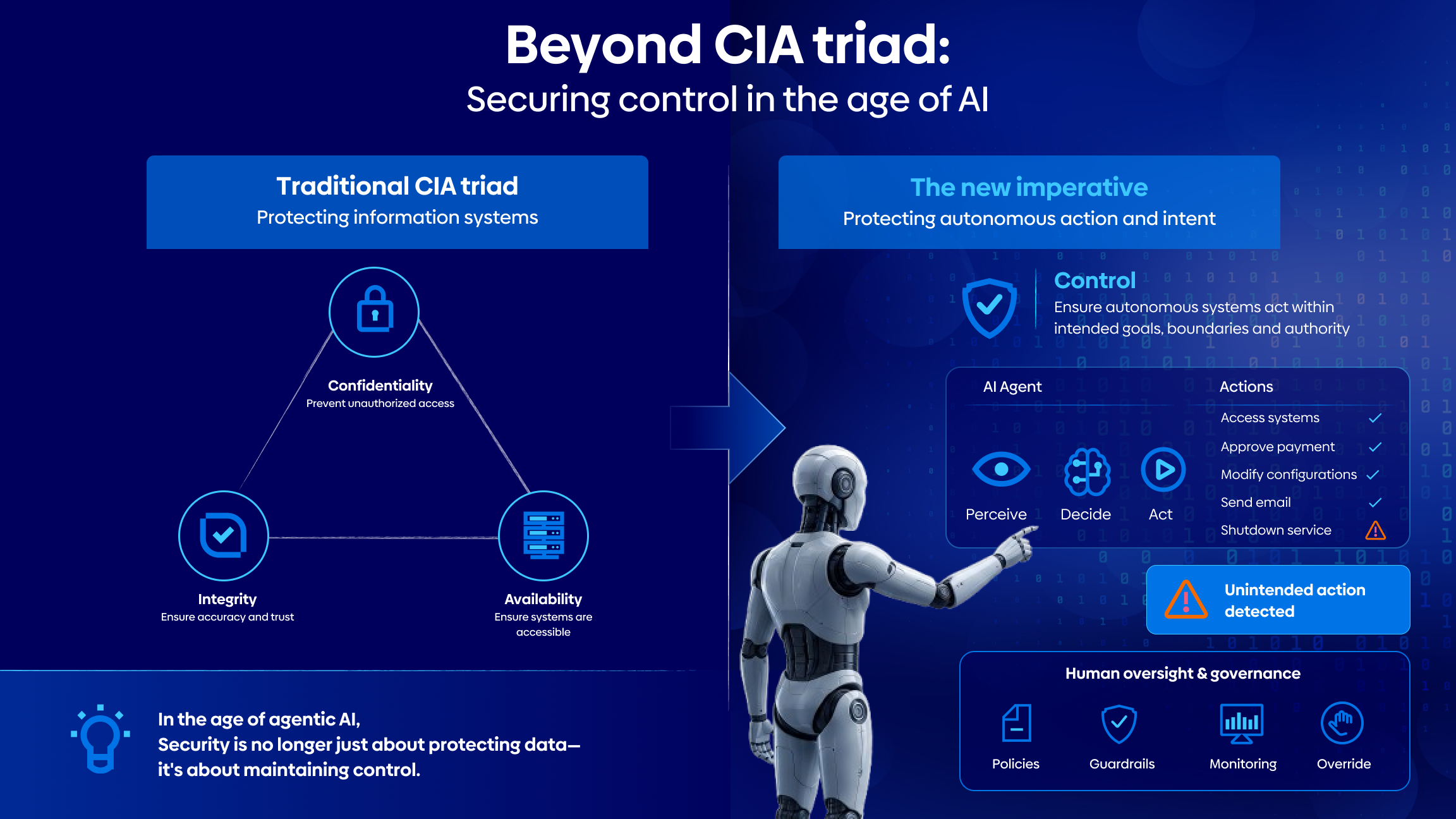
For decades, security has rested on three principles: keep data confidential, keep it accurate, keep it available. Confidentiality, integrity, availability — the CIA Triad. Every security professional learns it on day one, and it works for protecting information.
But this was designed for a world where the primary risk was humans accessing, stealing or corrupting information. Today, AI systems don’t just hold data, they act on it. They make decisions and take actions before anyone grants permission and the team often finds out only after the fact.
The Atos Group whitepaper on Adaptive Cyber Resilience calls out this shift clearly. As AI moves from generating outputs to taking actions, the risk is no longer just data exposure. It is loss of control, goal drift and unintended autonomous behavior.
This is why a growing number of security thinkers are arguing that the CIA Triad needs a fourth pillar: control. This will ensure AI systems act within intended boundaries; not just protecting data but keeping AI systems inside the boundaries we set for them.
Two very different groups are reaching the same conclusion:
- Security teams through the daily routine of agentic threats and autonomous movement inside networks
- AI researchers through model behavior and loss of control over autonomous systems.
Essentially, the people defending against AI and the people building it are pointing at the same gap.
Resilience: An operating model, not a tool
Here is where most organizations get stuck. Faced with an expanding threat landscape, the instinct is to buy more tools, add more controls, run more audits. It feels like progress, but it rarely is.
The Atos Group whitepaper on Adaptive Cyber Resilience referred to earlier clarifies the diagnosis: adding tools hasn't closed the gap. The gap isn't about technology, it's about how you operate. Closing the gap requires a discipline built on three questions:
- How fast can a breach be detected?
- How fast can it be contained?
- And how well can the organization recover?
It all comes down to this: Prepare. Respond. Adapt.
This changes the scorecard entirely. Security is no longer judged by tools bought or audits passed. It is judged by mean time to detect, contain, and recover. These are the KPIs a board can understand and hold someone accountable for.
What are the questions around cyber reliance that nobody is asking?
Adaptive Cyber Resilience is the right framework for today. And yet something critical is missing from the conversation. Defense will be agentic. No human team reviews and acts in 27 seconds. So defensive AI that responds autonomously is not a question, it is a requirement. But the hard questions sit one layer down.
First: control. If the defense acts on its own, who keeps it inside its boundaries? Who has authorized that containment? Who answers for what the agent did while the team was still reading the alert?
Second: the arms race. When both sides are agentic, the fight becomes model against model. The question is not whether agentic defense is used, it is whether the model is better than the attacker's. If theirs is faster and smarter, human accountability is cold comfort.
These are not hypotheticals. They are happening right now.
But here is what the industry consistently avoids: the technology is often ready before the organization is. Machine-speed tools get deployed into human-speed cultures. Automated triage sits behind manual approval chains. Al-augmented SOCs are staffed by teams that were never asked whether they trust the machine or trained for the moment when they have to decide whether to override it.
The real vulnerability is not the firewall.
It is the moment a human has to make a judgment call at machine speed and nobody prepared them for it.
Cyber resilience and what it means for you
AI-driven threats do not follow business hours. They probe, pivot, and execute faster than traditional security operations were ever designed to respond. But the answer is not simply faster tools.
The organizations that close this gap will not just have better technology. They will have built the culture, the governance and the human judgment to operate alongside it. That means asking harder questions than, “Are we protected?” It means asking more hard-hitting questions like: “When the machine acts, who owns that decision?” or “When the alert fires at 3am, does the person reading it have the mandate and the confidence to respond or are they waiting for approval from someone who is asleep?”
Cyber resilience in the age of Al is not a procurement decision. It is an organizational one. If attackers operate at machine speed, defenders must too. But machines do not lead organizations. People do.
>> I would like to hear from you. Connect with me and let us discuss your approach to autonomous AI-driven threats and your take on cyber resilience.



Categories
Related posts
- The future of humans and AI in the digital workplace
- Microsegmentation: The security upgrade you can’t ignore (Part 2)
- GenAI in application design: does it make a difference? A field experiment using Pega’s Blueprint
- Product Lifecycle Management in the age of AI: Engineering trust for regulated industries
Dive Deeper