Testing in the age of agentic AI
With Atos’s Intelligent Quality Engineer
Software quality assurance is a critical part of any product or service development journey, centered around the key belief and confidence that the product or service is developed according to its intended purpose.
In the past, testing purposes and this associated confidence were created using deterministic methods such as scripted tests, rule-based checks, and human-led verification cycles. All those methods of validation worked well in a world where software was developed by humans, systems were subject to programmed outputs, and changes were made one step at a time. However, with the rapid emergence of artificial intelligence (AI) systems, the world we grew up in has changed dramatically.
The need of the hour
In this AI era, we see a paradigm shift in the way software applications are delivered and deployed.
Today, it’s built in days and not in weeks, but such swift development poses a risk. AI-generated code carries subtle defects that evade standard testing. Modernized applications behave unpredictably.
Large-scale migrations — like application modernization, data modernization, cloud modernization, and SAP ECC to S/4 HANA — trigger unexpected functional failures and prolonged business disruption.
Existing testing methodologies and approaches need to keep up with the pace to maintain speed and quality.
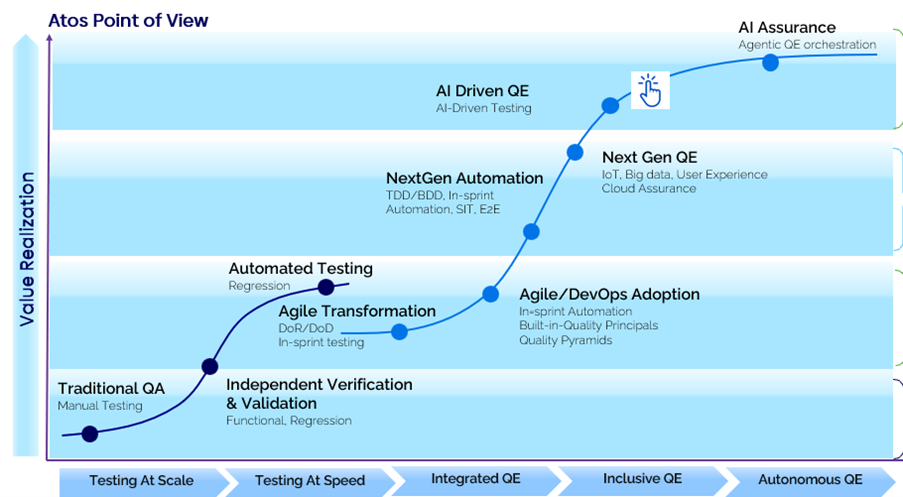
The journey of testing
Development teams doing testing
In the early stages, quality wasn't a dedicated process. It was something developers squeezed in between coding tasks. Most testing was just manual checks to make sure the basics didn't break. While that kept feedback loops tight, it didn't offer the rigor required for complex environments. It often led to that classic 'works on my machine' trap, where testing felt reactive and undocumented rather than a shared, disciplined standard.
Testing teams at CoEs
As systems became more complex, the industry realized that their testing methods weren’t enough anymore. Launching a Testing Centre of Excellence (CoE) seemed to be the way forward to fill the gap. These centralized teams transformed QA from a developer’s side-task into a specialized testing team. By standardizing tools and metrics, they finally brought value and quality. It was the first real commitment to governance — ensuring every release hit a consistent standard of excellence before going live.
Quality at speed using automation and testing tools
The rise of Agile and DevOps made the previous manual gates a bottleneck, forcing QA professionals to automate or fail. Shifting from manual execution to automated regression suite, the new methodology required building and execution using automation tools to deliver quality at speed. The CI/CD pipeline was created to execute the embedding automated regression suites whenever there is a code deployment.
This era wasn't just about faster scripts; it was about building a culture where testing happened continuously, allowing us to deploy updates daily without the constant fear of a total system collapse.
Machine learning evaluation
However, testing hit a wall where standard automation couldn't keep up with dynamic UI changes or massive data sets, leading us to machine learning (ML). ML was utilized for very targeted, specific problems, such as prioritizing the regression test cases, identifying the impacted test cases, defect hotspots, and test data retrieval., based on the impact of code changes and highlighting flaky tests whose results were inconsistent.
By using ML insights for regressions and predictive analytics, the tester has a clear direction of what to test and by concentrating the area on what mattered most rather than testing everything. It turned data into a roadmap, helping spot anomalies and high-risk patterns.
Gen AI
Generative AI (Gen AI) completely changed the way we generate and execute tests with improved speed and quality. It took over the heavy lifting, now resolving ambiguity in requirements, drafting test scenarios and test cases from messy requirements, generating test data, and generation, maintenance of automation test scripts. For the first time, the bottleneck of creating test assets began to vanish, allowing us to focus more on strategy and less on the syntax of our scripts.
Agentic AI
Today, we are entering the era of agentic AI, where the system doesn't just help us work — it works on our behalf. These QE agents play the role of generating test scenarios, cases, self-heal a broken test when the UI changes, and even decide which tests to run, based on a risk assessment. We’ve moved beyond simple automation into true orchestration, where the AI acts as a digital engineer / teammate that manages the quality lifecycle with minimal human handholding. Atos’s agentic AI-based Intelligent Quality Engineers (IQE) platform delivers unique value with features like predefined workflows, prebuilt agents, intelligent test generation and sovereign by design, leveraging Atos’s deep-test expertise domain knowledge. Its agentic systems continue to gain planning, learning, and action capabilities under human supervision.
With Atos IQE, companies can quickly create new applications using AI or drive significant enterprise transformation by ensuring confidence, compliance, and control throughout the process. It accelerates cycle time while improving decision quality at speed and at scale. Located within the client's infrastructure, the platform ensures data remains in the correct location, remains compliant and remains under the client's control.
Agentic AI and the way forward
In the agentic era, AI employees are not a choice to have; it is the need of the hour. Atos IQE serves as a company's quality assurance partner at every stage of its transformation, providing a continuous, real-time quality assurance solution through its agentic architecture that is agile enough to keep pace with innovation.
Agentic AI is proving to be a revolutionary game-changer across testing and quality in the product and service development ecosystem. Either you level up or get left behind.
>> Connect with us to learn how you can get started today.
>> Learn more about Atos’s IQE and how it can accelerate your business’ testing strategy and QA journey.





Categories
Related posts
- Leading AI adoption: Why change starts at the top
- GenAI in application design: does it make a difference? A field experiment using Pega’s Blueprint
- Product Lifecycle Management in the age of AI: Engineering trust for regulated industries
- The economics of agentic AI: Questions to ask before implementation
Dive Deeper

Digital Assurance
Learn more