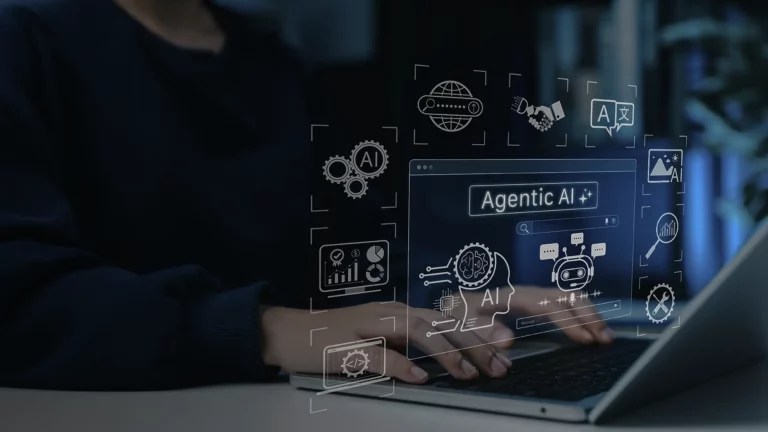
Services-as-Software: Why the next software revolution will eliminate software as we know it
For decades, software has followed a familiar pattern. Business teams describe what they need, while analysts translate it into requirements. Architects design the solutions And developers write code Before operations teams deploy it. Security teams review it, and then, after months – or even years sometimes – the business finally gets what it asked for. Or at least, what it asked for two years ago.
That entire model is becoming obsolete.
A growing number of technology leaders are pointing toward a new paradigm: Services-as-Software (SaS). Not software delivered as a service, but the idea that software itself becomes an assembly of intelligent, composable services that can be orchestrated directly by business users and AI agents. The implications of this are profound. And perhaps slightly uncomfortable for an industry that has built its identity around writing code. This is the core of Atos’s transformation from Managed Services to an orchestrator of Services-as-Software.
From writing code to describing intent
There is a compelling argument that the evolution toward SaS is not primarily driven by AI. Instead, it is the culmination of several architectural trends that have been quietly unfolding for years.
- Virtualization
- Cloud
- Containers
- Infrastructure as Code
- Platform Engineering
- Composable architectures
- Low-Code/No-Code platforms
- GenAI and Agentic AI
Each step shifted the complexity away from the underlying technology and moved the focus upward – from servers to platforms, from platforms to services, and increasingly, from services to business outcomes. GenAI and Agentic AI now accelerate the transition from composing services to expressing business intent.
This progression is strongly reflected in the architectural direction and coding developments:
- From prescriptive (installation and configuration manuals) to descriptive (this is what I need and how it should be considered, the deployment software takes care of the rest)
- From monolith platforms to modular architecture and to composable services.
Composable services, platform engineering, AI orchestration, digital resilience, and business agility become foundational principles for future enterprises. Viewed through this lens, SaS is not a revolutionary leap. It is simply the next logical abstraction layer. Now, instead of writing software, organizations will increasingly describe business capabilities. The system figures out the rest.
The rise of composable intelligence
The most interesting aspect of SaS is not the technology itself, but who gets empowered. Historically, innovation was constrained by technical expertise. If a business leader wanted a new capability, they needed technical specialists (which was scarce then) to translate ideas into software. Composable services started breaking that dependency. Organizations are increasingly assembling solutions instead of building them from scratch. The Atos strategic vision highlights this shift toward reusable platforms and composable capabilities that allow organizations to innovate faster while maintaining governance and resilience.
The next step appears obvious: If services become rich enough, why would a business expert need a developer?
A finance specialist understands financial processes better than any developer. A supply chain manager understands logistics better than any programmer. A healthcare professional understands patient journeys better than a technical architect. In a mature SaS world, these experts may directly compose business functions themselves. Technology becomes invisible to the business developer as it is packaged in a composite of composable services.
The architecture and development framework, read operating model, needs to be mature and robust:
- Product ownership remains accountable
- Architects define guardrails
- Service ownership remains essential
- Decision logic requires explicit governance
- Enterprise architecture becomes more important, not less
In summary, the business demand and the IT supply becomes a controlled interface that can be a self-service portal for the business with consumable rich composite services.
GenAI: Accelerating excellence
This is where the story becomes particularly interesting. Many observers claim AI will create SaS. We would challenge that narrative. SaS was already emerging before Generative AI appeared.
"What GenAI and Agentic AI provide is acceleration. They become the universal translator between human intent and technical implementation."
Instead of assembling services manually, users describe desired business outcomes. Consider this example:
"Create a customer onboarding process that validates identity, performs risk assessments, complies with local regulations, and generates management reports."
The AI agents will complete the following:
- Discover services
- Orchestrate workflows
- Configure integrations
- Create documentation
- Reasons and orchestrates workflow
- Checks for regulation, compliancy and guardrails
- Continuously optimizes the process
The missing piece of the puzzle: Governance
Here is the provocative question: If everybody can build business capabilities, who governs them? History suggests that every technology abstraction creates a period of innovation followed by a period of chaos.
- Cloud democratized infrastructure.
- Organizations responded with FinOps.
- Data democratized analytics.
- Organizations responded with Data Governance.
- AI democratizes intelligence.
So, how can we ensure separation of accountabilities for process orchestration, deterministic decisioning, and agentic reasoning?
- Agents that perform deterministic tasks should be implemented with deterministic algorithm – not with a language model.
- There is human accountability for the behavior of each agent. This is simple if an agent is acting deterministically, more involved when it comprises of a reasoning language model. This is where the observability data is key. At best such an agent is autonomous, but with human oversight in the decisions and outcomes.
- All AI agents deliver high quality observability data, including their reasoning decisions, actions and outcomes. These are inputs to the last two types of agents, which have explicit human-in-the-loop checking on behavior, decisions and outcomes.
In his recent article on Empowering Business growth – How you can secure your enterprise from AI risks with SaS, Peter Kalmijn provides guidance how governance is ensured and Services-as-Software brings the architectural pattern in which services become software defined value engines, governed by guardrails, driven by explicit decisioning, and capable of safe autonomy through agentic AI.
What comes next?
Recent Atos perspectives on Digital Sovereignty argue that retaining control over data, applications, infrastructure and digital operations becomes increasingly important as organizations depend on external ecosystems and AI-powered services. Digital sovereignty is therefore presented not as a compliance exercise but as a strategic capability.
The same concern applies directly to SaS. When services become autonomous and AI agents orchestrate business processes, governance becomes more important. Organizations that fail to establish architecture principles, security controls, platform governance, and sovereignty frameworks may find themselves with thousands of AI-created business processes that nobody fully understands. That's not agility. That's anarchy.
Security cannot remain an afterthought
Many advocates assume composable services inherently make organizations safer because experts build the underlying services. Reality is slightly more nuanced. The Atos cybersecurity vision argues that static perimeter-based security models are increasingly ineffective in dynamic, AI-enabled ecosystems. Instead, organizations must shift toward adaptive cyber resilience, continuous monitoring and continuous control.
SaS dramatically increases dependency chains. A single business process may consume dozens of services across multiple providers. Every new service is another trust relationship. Every AI agent is another potential attack surface. Success is therefore unlikely to depend on how fast organizations compose capabilities. Rather, it will depend on how effectively they govern, monitor and secure them.
So, will developers disappear?
Probably not. But their role will change dramatically.
"Describe the outcome. Let the system do the work. Keep humans in control."
The software engineer of the future may spend less time writing code and more time in the following activities:
- Designing composable capabilities
- Building reusable service products
- Defining governance policies
- Managing AI agents
- Ensuring sovereignty and compliance
- Designing resilient enterprise platforms
The transition resembles the shift from assembly language to high-level programming languages. Developers did not disappear, they simply became more powerful, and the same will likely happen again.
Building the enterprise as a platform with SaS
Taken together, the key themes discussed in this article and supported by Atos’s strategic pillars point toward a future where organizations evolve from managing technology stacks to operating intelligent digital ecosystems. This vision combines agentic AI, composable services, digital sovereignty, adaptive cyber resilience and platform-based operating models. The related perspective in the earlier mentioned Peter Kalmijn article further connects SaS with the challenge of managing AI-driven innovation while maintaining control and security. In this view, software does not disappear. It becomes infrastructure for business intent.
How SaS is revolutionizing businesses
The most radical aspect of Services as Software may not be technological at all. It is organizational.
The future is not about writing software. It is about describing outcomes and ensuring autonomous systems deliver them responsibly.
For fifty years, businesses adapted themselves to software. SaS proposes the opposite: Software adapts itself to the business, but requires the right governance to ensure it meets its goals and acts within the guardrails, responsibly. If that vision becomes a reality, the winners will not be those who write the most code. They will be those who best articulate intent, govern digital ecosystems and orchestrate increasingly intelligent services. And that may be the most disruptive software revolution yet.
>> Connect with the Future Makers Research Community (FMRC) and the representatives of the Next Generation Architecture Technology Chapter within FMRC to continue this discussion and explore what this shift could mean in practice.
Erwin Dijkstra
Enterprise and Data Architect, Member of Future Makers Research CommunityFuture Makers Research Community
View detailsof Erwin Dijkstra >


Pawan Choudhary
Senior Consultant, Member of Future Makers Research CommunityFuture Makers Research Community
View detailsof Pawan Choudhary >
Categories
Related posts
Dive Deeper