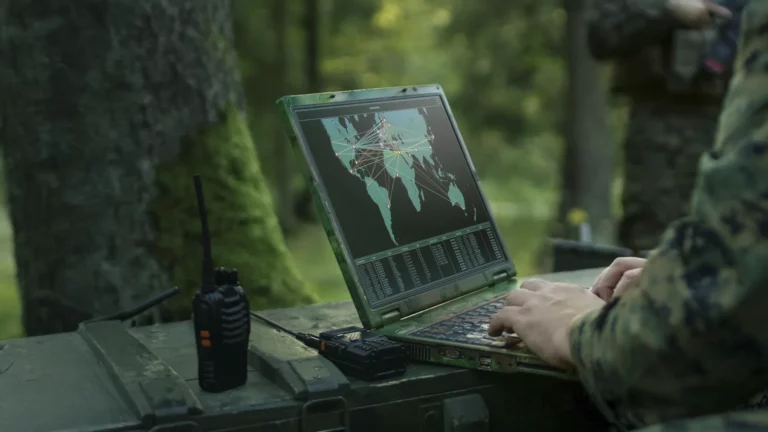
One platform, many nations
Digital sovereignty in the era of joint defense assets
Fighter aircraft, submarines, armored vehicles, and naval systems are developed over decades and remain operational for 30, 40, and sometimes even 50 years. Yet alliances, regulations, and geopolitical climates shift far more quickly. This creates a structural tension at the heart of modern defense programs. Joint development across nations must coexist with sovereign control over critical intellectual property and data.
Having worked closely with multinational defense programs, I have seen how quickly digital collaboration models are tested when political conditions change. Seemingly stable at program launch, the same model may look very different ten years later. The century-long collaboration between Pratt & Whitney and MTU Aero Engines demonstrates how industrial trust can span generations.
But digital architectures were never designed with century-long geopolitical volatility in mind.
When collaboration becomes a sovereignty risk
Programs such as the Future Combat Air System (FCAS) illustrate this tension vividly. These are not simply aircraft programs. They are system-of-systems architectures built across nations with differing strategic priorities and regulatory constraints. In practice, this means its engineering teams need to collaborate deeply across borders while political stakeholders demand sovereign control over data, models, and mission-critical capabilities.
No single entity can own the entire digital thread, i.e. a stream of data that connects various stages of a product’s lifecycle, enabling real-time decision-making, collaboration, and integration. Yet lifecycle continuity must be guaranteed across decades of development and operation. From an architectural perspective, collaboration and sovereignty are no longer opposing forces. They must coexist by design.
Technology transfer without digital surrender
The same dynamics are unfolding beyond aerospace.
The submarine collaboration between Thyssenkrupp Marine Systems (TKMS) and Mazagon Dock Shipbuilders Limited (MDL) reflects another dimension of this challenge. Naval programs require deep industrial cooperation, localized manufacturing, and structured technology transfer. But in today’s environment, technology transfer cannot mean uncontrolled digital exposure. Supporting such programs requires carefully architected digital environments where engineering data can be shared selectively, governed dynamically, and, if required, segmented clearly.
The platform may be exported. Sovereignty cannot.
One armored vehicle, multiple sovereignties
The Boxer is an armored vehicle that provides a similar lesson from land systems. A single platform spans multiple industrial bases, distributed production environments, and evolving upgrade cycles across nations. In these contexts, configuration control is not merely a technical discipline — it becomes a geopolitical one. Access rights, engineering ownership, and lifecycle responsibilities must evolve over time without disrupting operational coherence.
Across air, sea, and land, the pattern is consistent: Behind every multinational defense platform lies a complex digital thread that must withstand political as well as technical stress.
Collaboration is mandatory. Sovereignty is non-negotiable.
Contractual vs architectural design limitations
Traditional PLM environments were optimized for integration, efficiency, and central governance. They assume stable ownership models and long-term alignment between partners. In multinational defense ecosystems, those assumptions no longer hold.
Shared intellectual property such as design models, manufacturing processes, certification artifacts, and service intelligence becomes deeply interconnected across organizational boundaries. Once tightly coupled in centralized systems, separating access or reasserting sovereignty becomes disruptive and expensive. Now, this is not simply a contractual issue. It is an architectural design limitation that becomes visible only under geopolitical pressure.
Maintaining digital continuity
In the midst of geopolitical changes and structural dynamics, a digital thread must evolve from a connectivity concept into a sovereignty-aware control backbone. Traceability is key even as access rights change. Collaboration must remain possible without permanently exposing sensitive information.
Data continuity must survive political shifts, export constraints, and evolving workshare models.
In my experience, this requires treating the digital thread not as a monolithic platform, but as a logical architecture connecting federated environments. The objective is continuity without centralization, visibility without loss of control.
From monolithic platforms to federated defense ecosystems
If they are to support multinational defense programs, digital ecosystems must be federated by design. Data must remain under the control of its rightful owner while being accessible through governed interfaces. Identity-centric security models, policy-driven access controls, modular data architectures, and secure exchange layers allow sovereignty rules to be enforced dynamically. This philosophy aligns with broader initiatives such as Gaia-X, but in defense programs the driver is not policy ambition — it is operational reality.
Digital systems must assume that alliances may shift, regulatory constraints may tighten, and industrial roles may evolve over the lifecycle of a platform. Architectures must absorb that instability without resetting decades of engineering knowledge.
Sovereignty: A design constraint or the new norm for collaboration
The era of joint defense assets demands more than technical excellence. It demands architectural foresight.
Platforms will continue to be engineered collaboratively across nations. Workshare will remain politically and industrially essential. But digital sovereignty can no longer be treated as a compliance layer added after system deployment. It must be embedded into the very structure of the digital thread — designed into data models, identity frameworks, cloud strategies, and integration patterns from Day one.
In the coming decade, the competitive advantage of defense programs will not be defined solely by performance parameters or technological superiority, but by the ability to collaborate at scale while retaining sovereign control. Programs that treat sovereignty as a constraint will struggle. Programs that treat it as a design principle will lead.
The real question for defense leaders, PLM architects, and system integrators is no longer whether multinational collaboration is possible. It clearly is. The question is whether our digital foundations are resilient enough to sustain that collaboration across decades of geopolitical change.
One platform may serve many nations.
But only sovereignty-aware architecture will ensure it serves them sustainably.
With over twenty years of delivering multinational end-to-end PLM programs, Atos brings deep expertise in managing complex defense workshare models across aircraft, naval vessels, and submarines, including the Eurofighter. We design sovereignty-aware digital threads built for the most demanding defense environments.
>> Learn more about how Atos is changing the face of defense and manufacturing with seamless transformations : Industry 360 Igniting industrial evolution through seamless transformations
Connect with me to discuss how your business can establish a modern, sovereign PLM landscape.
Posted 10/03/26

Murli Mohan Srinivas
Industry Partner / Specialized Sales PLM, Digital Twin
View detailsof Murli Mohan Srinivas >