Microsegmentation: The security upgrade you can’t ignore (Part 1)
Most security incidents do not begin as crises. They begin quietly, with a single compromised endpoint, a stolen credential, or an unpatched vulnerability. What determines the severity is what follows.
The decisive moment is not the initial breach. It is the attacker’s ability to move laterally and undetected across systems, applications and environments until they reach critical assets. For years, cybersecurity strategies have focused on prevention. Stronger perimeters, more sophisticated detection, and layered defense have all improved resilience. Yet in complex, distributed environments, prevention alone is no longer sufficient. Breach is no longer an exception. It is an operational assumption.
The strategic question for security leaders is shifting. It is no longer only about how to keep attackers out. It is how to control what happens when they get in. This is where microsegmentation becomes essential.
Redefining access. Reinstituting trust.
Microsegmentation redefines how access and trust are enforced within the environment. Instead of assuming internal systems are inherently safe, it limits connectivity to only what is explicitly required. Every application, workload, and interaction is treated with the same level of scrutiny, regardless of location.
In practice, this means that lateral movement is no longer trivial; attack paths are constrained, exposure is reduced and the blast radius of any compromise is contained by design. In hybrid and multi-cloud environments, where workloads are dynamic and identities extend beyond human users to services and automated agents, this level of control is no longer optional. It becomes a critical enabler of resilience.
Microsegmentation is not about complexity. It is about precision. It gives organizations the ability to translate security intent into enforceable policy at the level where risk actually materializes.
In an era where attacks increasingly rely on valid access rather than exploitation alone, controlling how systems communicate is as important as controlling who logs in.
Figure 1. Without internal barriers, one compromise can reach everything. With microsegmentation, the breach stays contained.
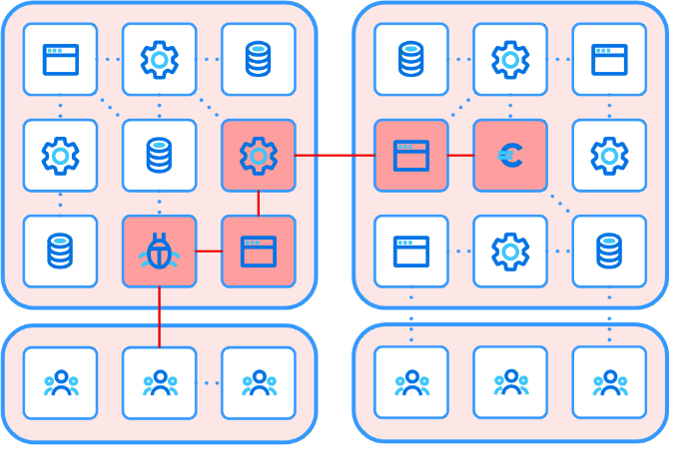
WITHOUT MICROSEGMENTATION
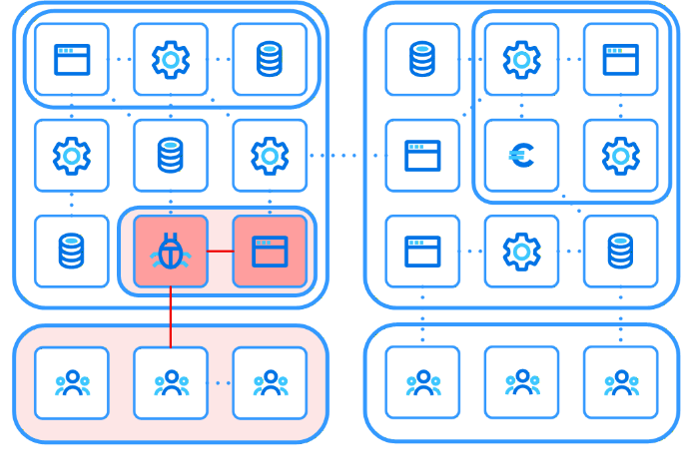
WITH MICROSEGMENTATION
A building with no locks
Picture your network as an office building.
Traditional security is designed to control the front entrance. Strong authentication, surveillance and access controls are all focused on deciding who is allowed through the door. On the surface, this creates a sense of security and control.
But the reality in many enterprise environments tells a very different story.
Once access is granted, the internal layout often resembles an open workspace rather than a series of controlled, secured zones. Systems, applications, and services are interconnected, with broad permissions and implicit trust allowing communication to flow freely.
In this model, a single compromised identity or device does more than provide access. It creates opportunity. An attacker no longer needs to force their way further in. Movement across the environment becomes a matter of navigating existing pathways.
The perimeter may be strong, but the internal exposure remains significant.
Now this is what microsegmentation does: It adds locks to the doors inside the building. Instead of leaving internal spaces open, it introduces enforcement at the level where risk actually materializes. Each room, in network terms an application or workload, is only allowed to communicate through predefined and necessary pathways. Access is no longer implicit. It is explicitly defined, continuously enforced, and limited to what is required for operations.
In practice, this translates into dividing the environment into granular security zones, where only approved connections are permitted and all unnecessary pathways remain closed by default.
The importance of this control becomes clear when viewed through the lens of lateral movement.
Lateral movement is how attackers expand their presence after initial access. It is the phase where a contained incident turns into a systemic breach. In most major security events, the initial compromise is not what drives impact. It is the ability to move across systems, escalate access and reach critical data.
By constraining movement, microsegmentation changes the outcome. It does not eliminate breaches, but it ensures they do not scale. What could have become widespread disruption is reduced to a contained, manageable event.
If an attacker slips in, they are stuck in one room instead of roaming the whole building
The window that keeps shrinking
For a long time, defenders operated with a comfortable buffer. When a new software vulnerability was discovered, there was typically enough time to apply a fix before attackers learned to exploit it. All the cybersec team had to do was patch promptly, and the risk could largely be contained.
That buffer is quickly vanishing.
Researchers at VulnCheck found that in early 2025, about a third of exploited vulnerabilities were attacked on the very day they became public, and sometimes even before. When the gap between a flaw being discovered and a flaw being exploited shrinks to near zero, patching alone is no longer a reliable defense.
Artificial intelligence is accelerating this shift.
Zero-day vulnerabilities, those exploited before a fix exists, have always been among the most difficult to defend against, but AI is now making them easier to identify.
In April 2026, the AI company Anthropic revealed that one of its models could uncover such vulnerabilities autonomously. The encouraging part is what came next: rather than release that capability, Anthropic gathered a coalition of major technology companies to use it for fixing vulnerabilities first. It is a good reminder that we, as a community, often get powerful new tools before attackers do.
A further development is the rise of AI agents. These are autonomous systems that perform tasks using their own credentials, operating continuously across environments. As their adoption increases, each agent introduces a new identity within the network, expanding the number of entities that can access systems and data.
Microsegmentation ensures that if any identity or workload is compromised, its access is constrained to only what is explicitly required.
In the second article of 2-part series, we will take a look at how organizations can adopt microsegmentation to contain breaches swiftly, impactfully and proactively. Stay tuned.

Marcin Lewandowski
Product Director - GDC CYS MS Hybrid Cloud & Plat. Security
View detailsof Marcin Lewandowski >


