From experimentation to orchestration: Rethinking the path to Agentic AI maturity
Moving from fragmentation to enterprise-wide impact
The current enterprise AI landscape is defined by a paradox: investment is accelerating, adoption appears widespread, and yet measurable enterprise-level impact remains inconsistent.
While tools are being deployed successfully, they are not being converted into sustained operational and economic value. This points to a critical gap in the market where decision-makers need to understand how to move beyond isolated AI use cases toward integrated, scalable systems that drive operational and economic impact.
Let’s take a look at the market scenario right now, and the direction it should be heading in for sustainable change.
Understanding the current market scenario
Despite rapid AI adoption narratives, most enterprises remain in early maturity stages:
- GenAI experimentation
- General-purpose LLM deployment
These include copilots, conversational interfaces, and developer assistants. While these tools drive localized productivity gains, they rarely scale into enterprise-wide transformation.
Additionally, many organizations fail to advance due to gaps in their governance and risk management, data and semantic infrastructure, system orchestration, operating model alignment and even workforce readiness. Without these foundations, AI initiatives remain stuck in pilot mode.
Challenges in broad AI deployment
Many organizations have adopted a shotgun approach, i.e. their broad, non-targeted strategy is flawed because they have opted for enterprise-wide tool deployment, decentralized experimentation and limited governance and alignment.
While effective in early exploration, this creates fragmentation and results in the following:
- Redundant use cases
- Inconsistent data quality
- Lack of measurable business impact
The result? High activity, low transformation.
The shift to Agentic AI Systems
The next phase of AI maturity is not about better tools — it is about better systems. Agentic AI represents a shift from assistive AI to autonomous, orchestrated systems.
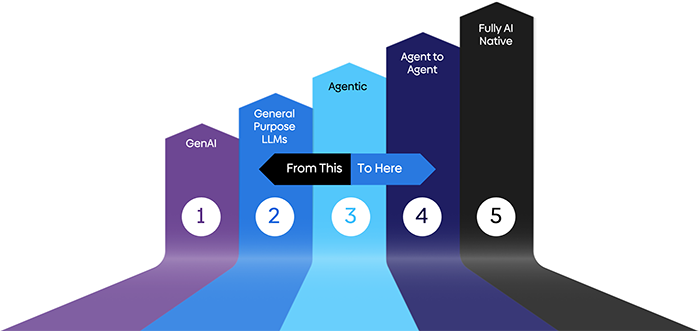
These systems enable:
- End-to-end workflow automation
- Coordinated decision-making
- Continuous optimization
- Scalable enterprise impact
From capability to system
However, it is important to note that AI maturity is not a linear adoption curve. It is a transition from capability accumulation to system integration. And organizations must shift from deploying tools to engineering AI-driven enterprise systems. Here’s how enterprise leaders can get started:
- Tool adoption alone is insufficient for an enterprise-wide transformation.
- Productivity gains must be measured at the system level.
- Governance is foundational, not optional.
- Competitive advantage comes from execution, not access.
Paving the way forward
The future of AI is not defined by how quickly organizations adopt tools, but by how effectively they redesign their systems around them. Organizations that successfully transition to agentic AI systems will unlock disproportionate value, while others risk remaining in perpetual experimentation.
>> Interested in uncovering more insights about faster and impactful Agentic AI adoption? Connect with us and let’s discuss this.
>> Find out how Atos’ Sovereign Agentic Studios are propelling our clients’ transformation stories. AI - Atos Sovereign Agentic Studios - Atos
Posted: 05/05/2026