
Artificial intelligence (AI) systems are no longer delivered as static artifacts frozen at deployment time. Rather, they are assembled from models, datasets, infrastructures, tools, APIs and external services that continue to evolve throughout the system lifecycle — from design and integration to operation, update and adaptation.
Cybersecurity authorities increasingly frame AI security as a supply chain challenge across the AI lifecycle, rather than a purely model‑centric or build time issue. This is because the effective risk profile continues to be shaped after deployment, as dependencies change, data evolves, and runtime interactions multiply.
Why AI supply chain security systems change after deployment
Like any digital system, AI depends on external components, third‑party services and integration mechanisms. The key question remains the same: What does my system depend on, and how can failures or changes in those dependencies affect me over time?
The dependencies themselves are not new. Models, datasets, APIs, cloud services, orchestration layers and update mechanisms are already familiar objects of the supply chain evaluation. Agentic AI does not eliminate component level vulnerabilities. A single flaw in a model, API, or tool can still have serious consequences, amplified by automation and scale. What autonomy changes is the systemic impact of dependency failures or weaknesses.
But with AI systems, the dependency chain is assembled at runtime and within predefined boundaries. Executions may differ, but that is not the issue. These are.
- Changes in upstream dependencies, such as data, can alter execution paths and outcomes.
- The same dependency (model, API, or data source) may be invoked repeatedly, under different contexts, combined with other dependencies, and may have different effects.
- Authorized dependencies, when combined and prioritized in specific ways, can alter business-level outcomes such as explanations and decisions, even when nothing is really broken. Over time, this can lead to loss of confidence in AI-supported decisions, difficulty justifying outcomes to stakeholders or regulators, and increased operational risk without any incident to investigate.
Dependencies that evolve: Models, data, integrations
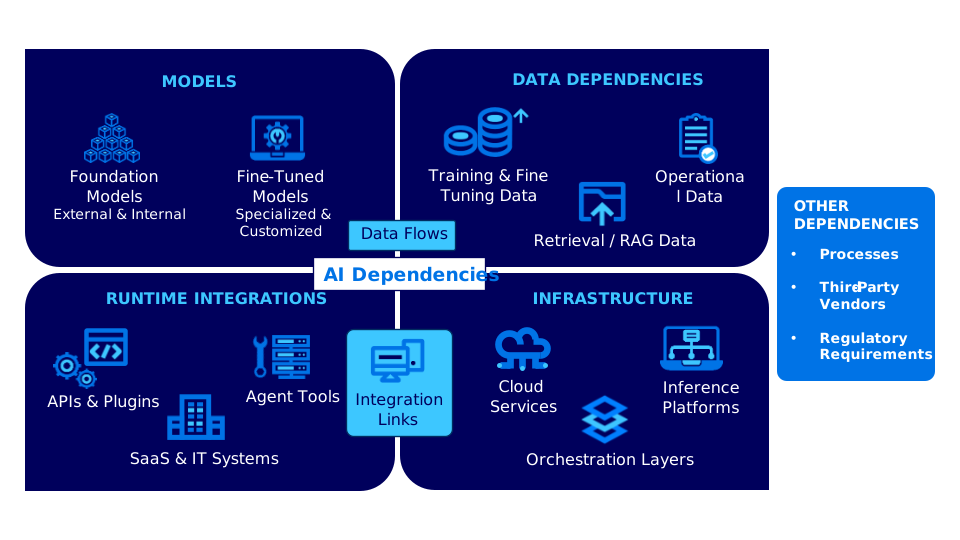
Models are often shared components, sourced from internal or external providers. Their risk profile is not limited to architecture or accuracy. Provenance, updated practices, and deployment context matter just as much. As models can evolve independently of downstream applications, their behaviors may change without any modification to business logic. From a supply chain perspective, models are moving dependencies, not static assets.
Data is an even more persistent dependency. Beyond training datasets, AI systems rely on fine‑tuning data, operational inference data, retrieval and grounding sources, feedback signals, and monitoring data. Consider a retrieval‑augmented system. The risk is not merely that an external document store exists (a classical concern) but that during execution, the system dynamically decides which sources to consult, how to combine them, and which outputs to generate based on context or prompts. In fact, a document added by another team, a permission change, or a shift in relevance ranking can alter systems behavior immediately, without any code change or exploit. In AI systems, supply chain risks can materialize even in the absence of an attacker!
Runtime integrations complete the picture. APIs, SaaS platforms, databases, and internal systems expose AI systems to runtime-specific risks such as prompt injection, capability escalation, and uncontrolled tool chaining, where authorized interactions can be manipulated to alter execution paths and outcomes. They also introduce systemic risk, as dynamic interconnections can amplify dependency failures, propagate errors across systems, and create unintended behaviors even when all components remain trusted and uncompromised.
Systemic Risk: Interconnections + Runtime Behavior
Fig 1. An overview of AI dependencies
Why traditional supply chains need an overhaul
Traditional supply chain practices focusing on inventories, versioning, certifications, and provider trust are insufficient. They assume that components are integrated in relatively stable ways, while AI dependency effects manifest primarily through system behavior rather than static integration paths. This is where traditional supply chain security falls short.
The real AI supply chain problem is whether you can anticipate, qualify, and govern the effects of authorized dependency usage across all valid runtime combinations.
Here’s how you can manage AI supply chain risk in practice:
- From static inventories to active dependency mapping
Classical supply chain security starts with inventories: Which models, datasets, APIs or providers are used? For AI systems, this view must be complemented with an active dependency map showing which authorized dependencies are invoked at runtime.
Two dependencies may both be approved and harmless when considered independently, but may create a risk when used together in a specific runtime context. This interaction‑level visibility becomes a supply chain requirement.
The “skills” layer
Some agentic architectures introduce a “skills” layer—predefined capabilities bundling tools, APIs, and execution logic under a business function.
Controls and observability remain valid at component level: policies are enforced on the underlying API calls and tool invocations used by skills, and these actions remain observable through telemetry.
However, this abstraction groups multiple actions into easy-to-use execution units, increasing system-level propagation risks (if a capability is flawed or overly permissive) and raising the likelihood of unintended interactions, as these encapsulated dependencies are reused and combined across contexts at runtime.
- From component trust to behavior qualification
As in AI systems, trust is attached to behaviors. Practically, this implies the following:
- Detecting when dependency usage patterns drift over time
- Identifying when a dependency becomes disproportionately influential
- Qualifying which runtime behaviors are acceptable, degraded or unsafe
This is not about blocking tools or retraining models by default. It is about understanding how the supply chain behaves in operation.
However, the underlying challenge is that cybersecurity teams think in terms of vulnerabilities, attacks, and misconfigurations, which are incident‑driven. They reason about components, not behaviors. Further, data science teams care about model quality and performance, bias, agent goal drift, or intent validation.
In many organization, ownership of the runtime dependency behavior is unclear or fragmented. As a result, organizations may struggle to clearly answer who is responsible for monitoring, qualifying and correcting behavior that emerges from authorized dependency usage over time.
Rather, all stakeholders need to adopt an approach that a document changed is behavior changed. Changes in upstream dependencies can materially affect downstream decisions without triggering any security signal or ownership boundary. These effects fall outside traditional cybersecurity detection and analysis models, creating a blind spot: runtime effects of supply‑chain changes remain invisible, even when systems are secure, scoped, and fully traceable.
From a regulatory perspective, this creates an additional challenge. Risk‑based frameworks increasingly require organizations to demonstrate not only that AI systems were designed with appropriate safeguards, but that their operational behavior remains controlled and explainable throughout the lifecycle. When decisions are shaped by dynamic dependency usage, the ability to demonstrate accountability, oversight, and control becomes a supply‑chain issue, even in the absence of incidents or attacks.
Managing the AI supply chain risks therefore does not mean pushing new analytical burdens onto security analysts. It means introducing dedicated capabilities to qualify and govern runtime dependency effects as a first‑class supply‑chain concern, rather than treating them as security incidents or data science issues. The objective is not to inspect individual document changes or explain every model decision. It is to detect patterns of dependency usage, shifts in dependency influence, and emerging execution paths that can alter business outcomes or risk exposure over time, even when all components remain authorized and uncompromised.
- From fixed control points to intervention capabilities
Supply‑chain management is not only about observation, but about the ability to act when a dependency becomes problematic.
For AI systems, this requires the following abilities:
- To suspend or restrict a specific dependency without redesigning the system
- To redirect execution paths to alternative dependencies
- To revert to assisted or human‑in‑the‑loop modes when behavior becomes uncertain
This is where supply‑chain security meets operational resilience.
- From static risk assessment to continuous qualification
Finally, AI supply chain risk cannot be assessed just once and then archived. Because dependencies, data, and runtime interactions evolve, risk must be continuously requalified.
The objective is not to predict every possible execution path, but to be able to accomplish the following:
- Detect emerging patterns of dependency usage
- Anticipate cascading effects of dependency changes
- Maintain control over how authorized dependencies shape system behavior over time
Next steps
In AI systems, supply chain security is no longer about protecting isolated components.
It is about creating dedicated capabilities, spanning security, data and platform expertise to govern dynamic chains of authorized dependencies as they are exercised at runtime, and to ensure their combined effects remain understood, controlled and reversible throughout the system lifecycle.
Let’s connect today to explore how to operationalize AI supply chain governance with control, visibility, and accountability.
Learn more about how Atos’ AI expertise has been instrumental in creating dedicated evolving AI ecosystems for their clients.
Share this article




Subscribe for regular insights
Control, Trust and Accountability at Scale

Agentic AI threat modeling: When AI starts acting

Cyber at machine speed: can your security program keep up?
Digital sovereignty in the age of AI: Control over decisions, not just data
Identity for AI Agents: The new nonhuman perimeter
Move from prediction to resilience: Navigating the new cyber equilibrium

Securing AI workloads across the hybrid and multi‑cloud AI supply chain